DataOps readiness
Assess whether industrial data is ready for analytics, agents, and digital twins.
The DataOps Readiness Assessment reviews source access, tag quality, asset mapping, schema gaps, governance needs, and the shortest path to an AI-ready product.
Source access
Tag quality
Asset mapping
Governance gaps
API/MCP fit
Activation plan
A practical assessment for the first source and asset class.
Platform in action
One operating layer across data, digital twins, agents, assets, and work
TwinEdge connects DataOps context, standard profiles, physics-based insights, spatial intelligence, AssetOps recommendations, and governed operational action in one platform experience.
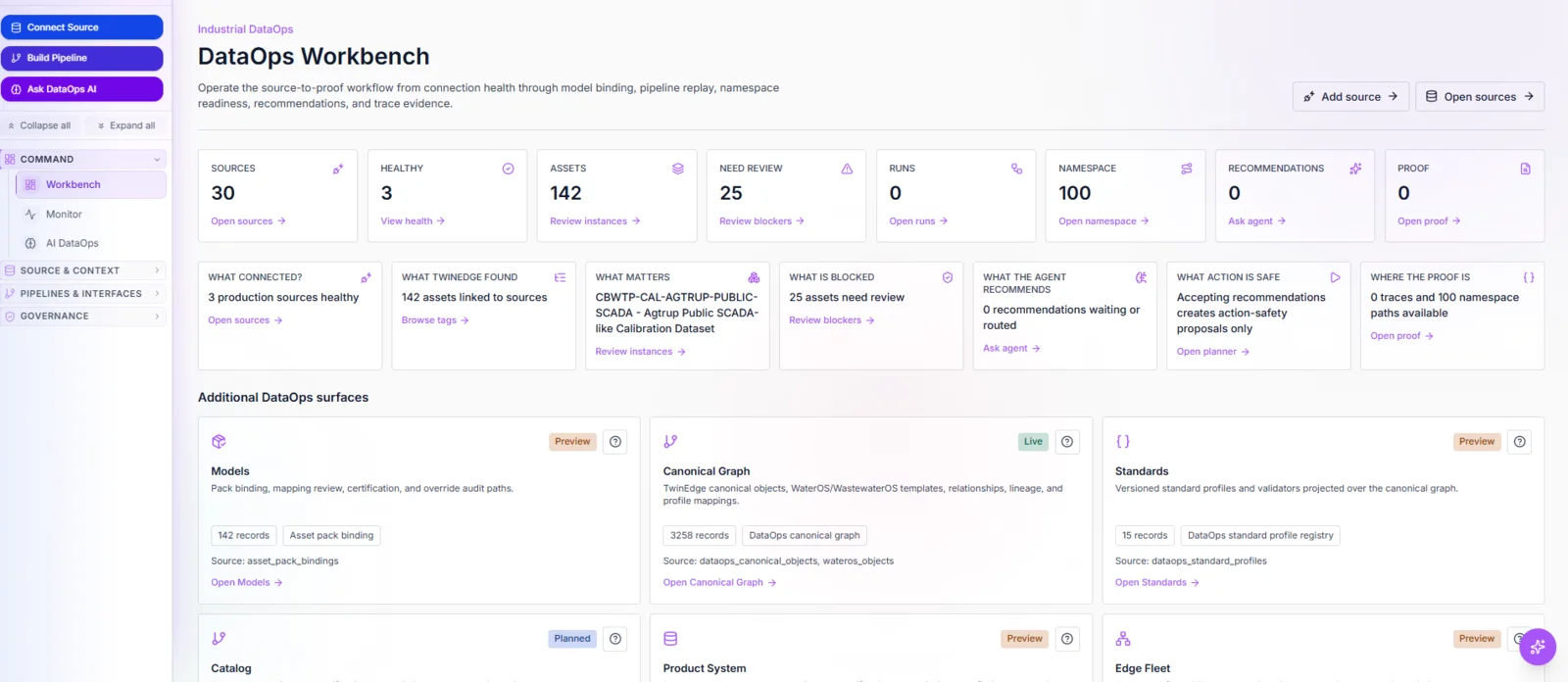
DataOps Workbench
The DataOps workspace shows source health, asset binding, namespace readiness, recommendations, models, canonical graph, standards, and edge fleet.
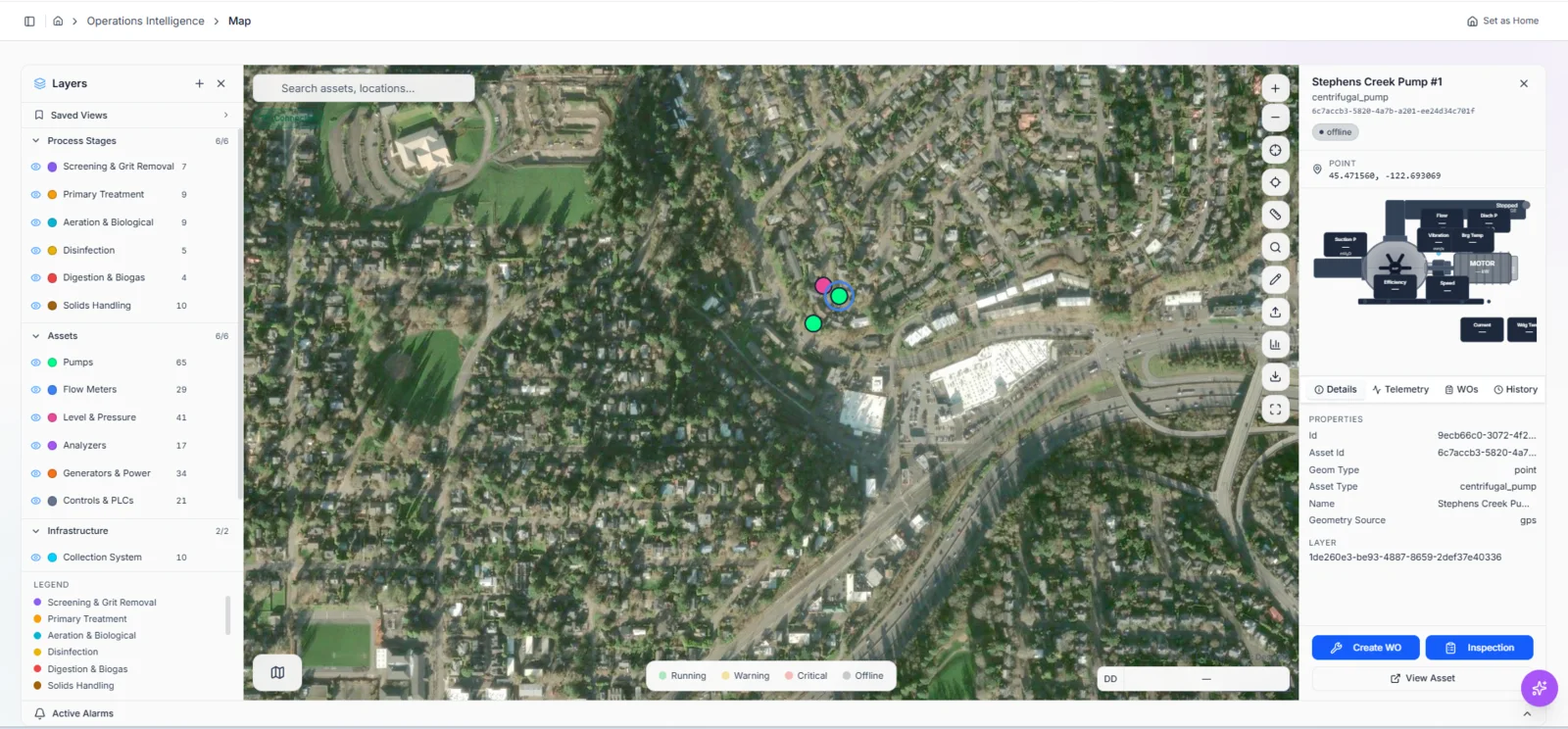
GIS and digital twin context
The operational map connects layers, asset detail, telemetry, work-order creation, inspection creation, and digital twin context.
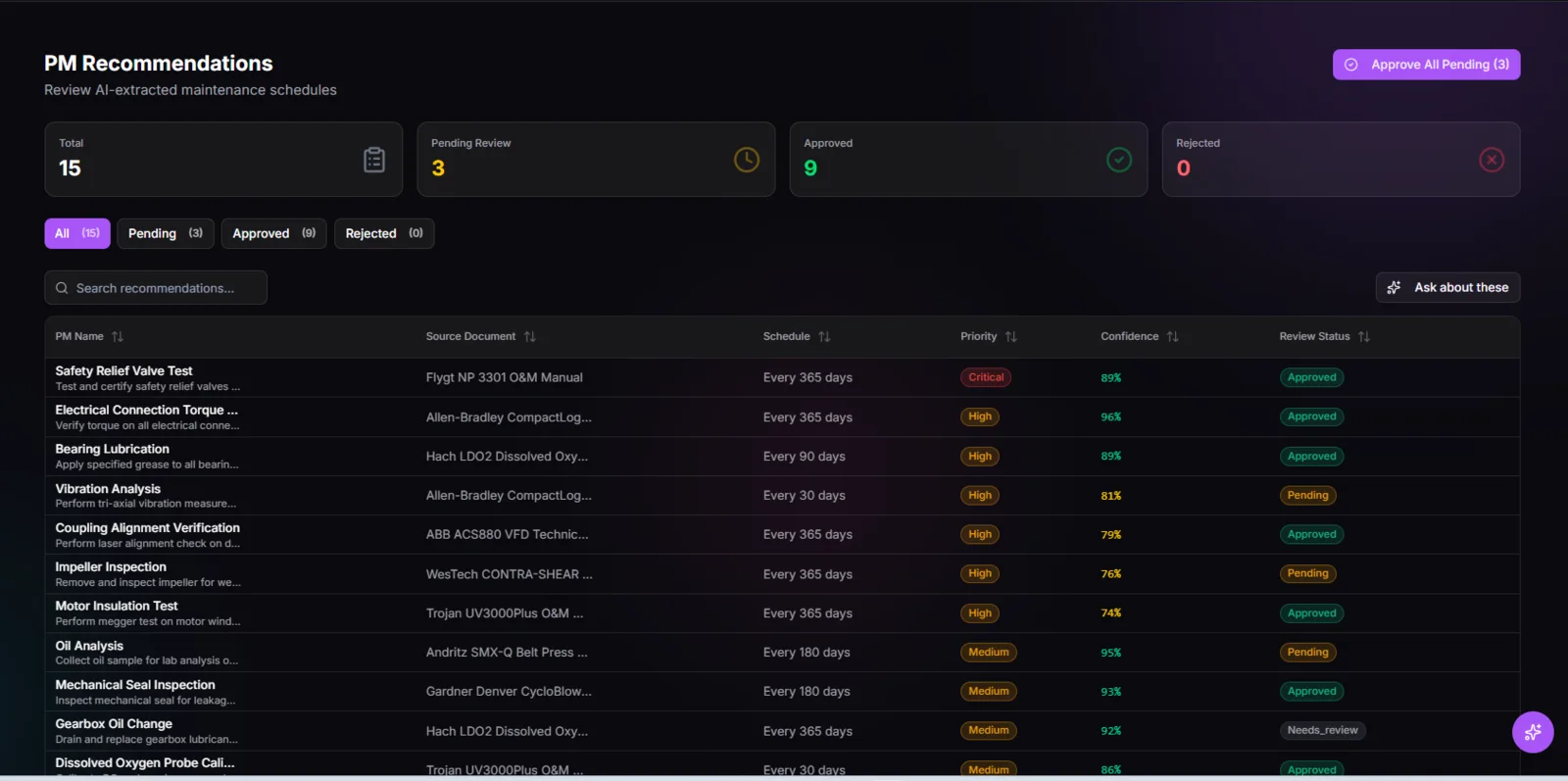
AssetOps PM recommendations
O&M-derived PM recommendations show source documents, schedule cadence, priority, confidence, and review status.
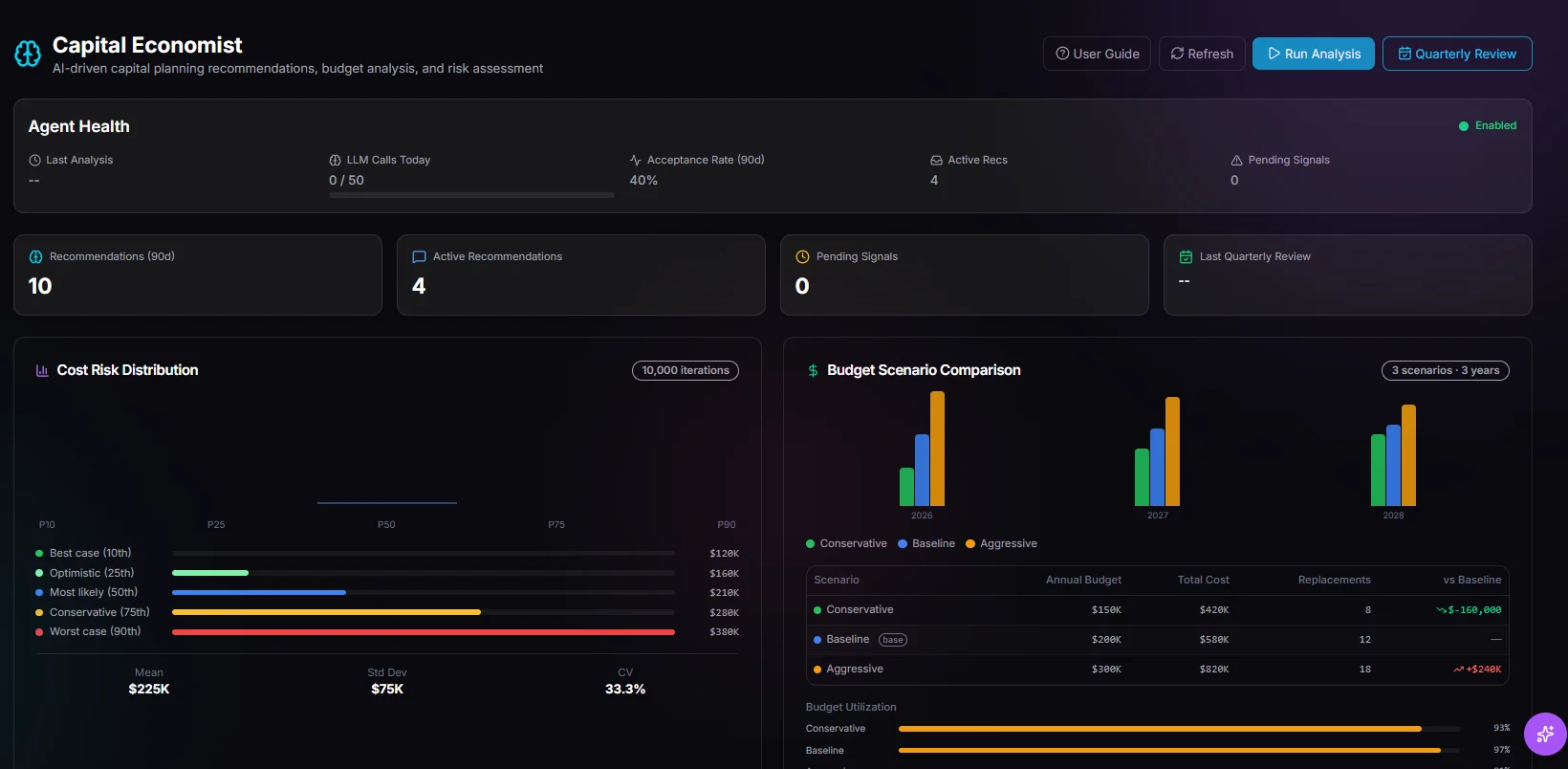
Capital planning recommendations
Capital Economist shows cost-risk simulation, active recommendations, scenario comparison, and budget utilization before funding decisions.
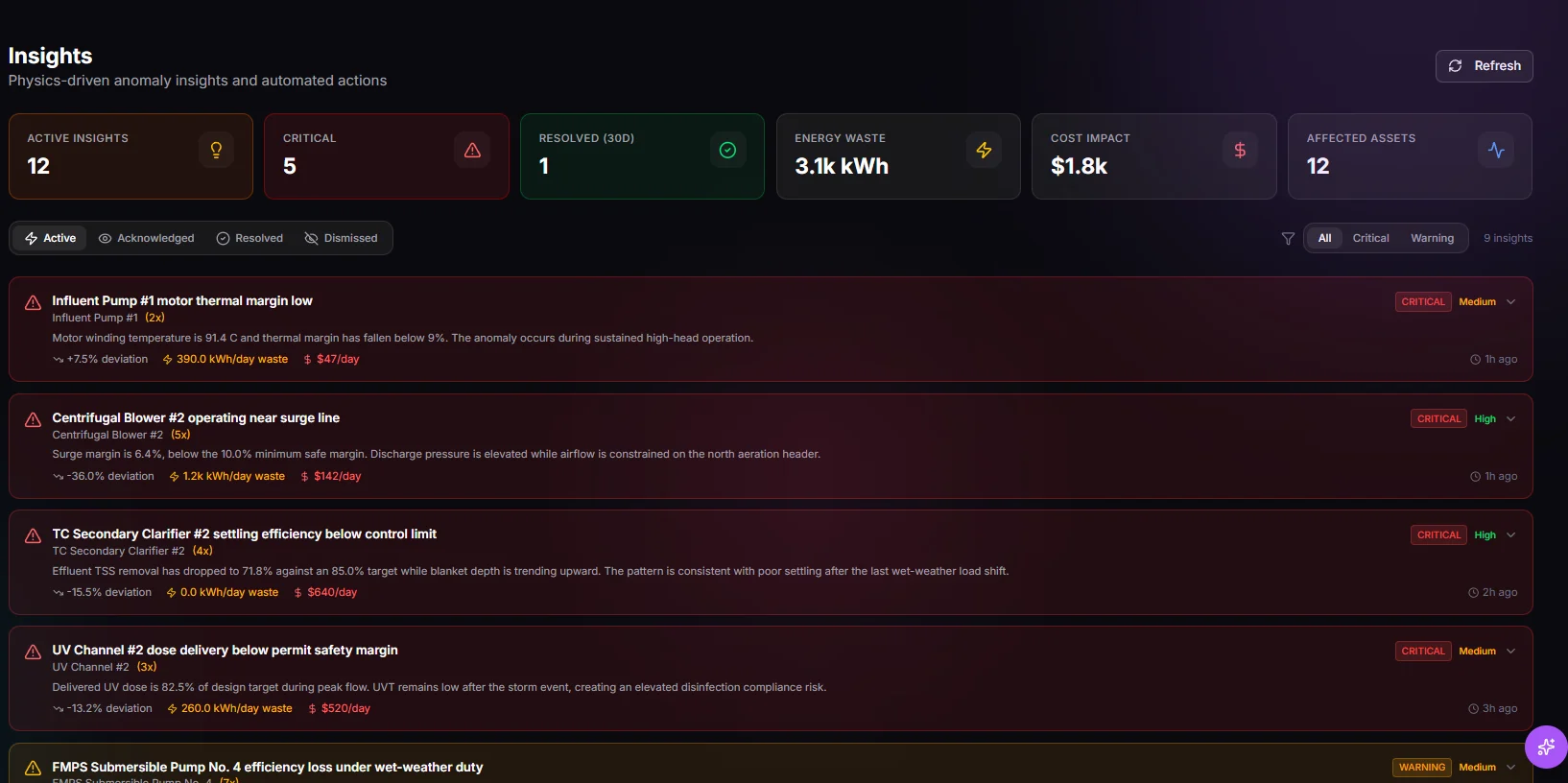
Physics-driven insights
Insights prioritize anomalies with severity, energy waste, cost impact, affected assets, and action-ready recommendation states.
Platform proof
One connected industrial AI platform instead of disconnected point systems.
TwinEdge gives asset-intensive teams the product coverage they need in one operating layer: data connection, digital twins, governed AI, EAM, field work, compliance, planning, edge runtime, APIs, and MCP.
1
Operating record
Shared context across data, assets, AI, work, and reporting.
10+
Product surfaces
DataOps, OS, agents, EAM, Field, Water, Quality, Capital, ESG, APIs.
0
Manual re-stitching
The same asset context follows every downstream workflow.
Workflow
From industrial data to decisions your team can defend
TwinEdge follows the complete decision path: connect the source, give the signal asset context, detect risk, recommend action, route approved work, and keep evidence for review.
Connect the systems already in place
Use cloud connector, Collector, OT Bridge, or TwinEdge OS to reach SCADA, PLCs, historians, MQTT, SQL, files, REST APIs, GIS, CMMS/EAM, LIMS, ERP, and edge systems.
Turn fragmented data into one operating record
Map tags, topics, tables, documents, and work history into asset models, namespaces, graph relationships, digital twins, and AI-ready data products.
Move from recommendation to work with evidence
Agents explain, draft, validate, diff, request approval, and carry source evidence into EAM, Field, compliance reports, APIs, and MCP products.
Capabilities
How the TwinEdge operating layer works
The platform brings edge runtime, Industrial DataOps, digital twin models, governed AI agents, work execution, and audit evidence into one connected architecture.
Industrial DataOps
A workspace for sources, tags, models, physics inputs, instances, pipelines, namespace, graph, catalog, APIs, MCP, and monitoring across operational systems.
Governed agentic analytics
Agents use operational context, physics model outputs, and operating envelopes to prepare evidence-backed recommendations with dry-run plans and approval gates.
Complete execution layer
AssetOps EAM, Field, Water OS, Wastewater OS, Chemical OS, Water Quality, Capital Planning, ESG, APIs, and MCP use the same trusted context.
The problem
Industrial teams are drowning in data but still short on operational truth.
SCADA screens, historians, GIS maps, CMMS records, lab results, spreadsheets, PDFs, and operator notes all hold part of the answer. When something goes wrong, teams lose time reconciling systems instead of acting on a trusted view.
Signals lack context
Raw tags and alarms rarely explain which asset is affected, how critical it is, what changed, or which procedure applies.
Work is disconnected from evidence
Maintenance, field work, compliance review, and capital planning often depend on screenshots, exports, and manual justification.
AI cannot help without trust
Generic copilots are risky when they cannot prove source context, role scope, approval state, and what evidence supports a recommendation.
Outcome proof
TwinEdge connects the cause, the consequence, and the next best action.
The platform is designed for measurable industrial outcomes: faster investigations, fewer avoidable failures, better maintenance decisions, lower operating waste, and cleaner audit evidence.
Faster exception response
Operators and engineers see the asset, telemetry, history, recommendations, and evidence trail in one investigation path.
More reliable work planning
Maintenance teams can prioritize work from condition, criticality, procedures, parts context, approvals, and recurring risk patterns.
Clearer executive reporting
Leaders can review operating risk, asset health, energy performance, compliance readiness, and capital needs from a consistent model.
Investigations
Find the reason faster when alarms, work history, and documents point in different directions.
TwinEdge gives teams a shared timeline of readings, events, operating state, recommendations, approvals, and work evidence so troubleshooting does not start from a blank search.
One timeline for the event
Bring telemetry, alarms, recent work, asset condition, procedures, lab context, field notes, and source evidence into the same review path.
Recommendations with boundaries
AI-supported findings show the source context, confidence, assumptions, approval state, and next action before work is handed off.
Replay for learning
Teams can review what happened, why a recommendation was accepted, who approved it, and how the final work was closed out.
Engineering controls
Engineering controls for industrial AI.
TwinEdge can show real telemetry, local inference, protocol flows, and agent traces without claiming uncontrolled autonomy or SCADA replacement.
Read-only first
Physical writeback is disabled by default and recommendations pass through approval gates.
Replayable evidence
Plans, diffs, source context, and approval history remain available for review.
Deployment choice
Cloud-connected, local, and offline paths support evaluation without forcing one architecture.
Source system respect
TwinEdge works above SCADA, historians, CMMS, GIS, LIMS, ERP, and data lakes rather than pretending to replace them all.
Outcomes
Customer benefits from the TwinEdge platform
The value is not another dashboard. TwinEdge helps industrial teams act sooner, explain decisions clearly, reduce waste, and preserve the record behind every recommendation.
Operations leaders
See a path from plant data to work, risk reduction, energy improvement, and evidence without replacing every existing system.
Engineers and IT
Get source visibility, schema discipline, governance, replay, and deployment options for cloud, no-cloud, and hybrid sites.
Executive teams
Start with a focused operational workflow and expand the same context across analytics, twins, EAM, Field, and industry packs.
Maintenance and field teams
Turn approved recommendations into work orders, routes, mobile execution, closeout evidence, and history without losing source context.
Connected platform
Extend the same context across the operating layer
DataOps Workbench creates the physics-aware, AI-ready context.
Agentic Analytics uses that context to explain, draft, and validate recommendations.
TwinEdge OS supports cloud-connected, offline, and protocol-rich edge deployments.
AssetOps EAM and TwinEdge Field close the loop from recommendation to work, guided mobile diagnostics, human-reviewed evidence, and closeout.
Water OS, Wastewater OS, Chemical OS, Water Loss OS, Water Quality, Capital Planning, ESG, and Facility OS package industry workflows.
REST and MCP data products make context available to enterprise applications and AI systems.
Frequently asked questions
Questions about DataOps readiness
Clear answers for buyers, operators, engineers, and evaluation teams.
What is TwinEdge Platform?
TwinEdge Platform is the cloud and hybrid coordination layer for industrial operations. It connects governed data context, digital twins, AI agents, AssetOps, field work, compliance evidence, and reporting around the same asset model.
How do TwinEdge Platform and TwinEdge OS work together?
TwinEdge OS runs close to equipment for protocol access, local storage, inference, dashboards, alerts, and offline operation. TwinEdge Platform coordinates shared context, fleets, analytics, agents, work, and governance across sites.
Does TwinEdge replace SCADA, historians, CMMS, or ERP systems?
No rip-and-replace is required. TwinEdge can operate above and alongside existing SCADA, historians, GIS, CMMS or EAM, LIMS, ERP, and BI systems while reducing custom integration between them.
What makes the platform physics-grounded?
Asset and process signals can be evaluated against equations, performance curves, operating envelopes, failure modes, and engineering constraints. Those outputs stay attached to recommendations and work evidence.
Can TwinEdge AI agents change industrial systems without approval?
The public product is read-only and recommendation-first by default. Agents explain findings, draft plans, validate constraints, and route human approval before an operational handoff.
Related for search and evaluation
Primary product for asset management and maintenance work.
Condition, physics, and remaining-life workflows.
Governed recommendations with approval and replay.
Maximo, HighByte, MaintainX, Fiix, and field alternatives.
Definitions for CMMS, DataOps, UNS, twins, and agents.
Labeled benchmarks and pilot methods.
Evaluate TwinEdge
Plan your first TwinEdge workflow.
Review the operating model with our team, or download TwinEdge to evaluate the platform in your own environment.