Resources / ROI
ROI modeling for downtime, energy, quality, maintenance, and workflow automation.
TwinEdge ROI resources help teams estimate value from fewer unplanned failures, lower energy per unit, faster quality response, reduced manual reporting, better maintenance planning, and governed workflow automation without asking customers to expose sensitive operating data publicly.
Downtime
Energy
Quality
Maintenance
Compliance
Workflow time
ROI is public as a model and private when customer inputs become sensitive.
Platform in action
ROI model tied to activation scope
A public ROI framework can show value drivers while detailed customer inputs and assumptions are handled in a controlled workshop.
Workflow
How ROI is modeled
Connect industrial sources, build trusted context, govern recommendations, and turn approved decisions into operational work.
Start with a public framework
Use public value drivers for downtime, energy, quality, maintenance, compliance reporting, and manual workflow time.
Scope customer assumptions privately
Collect site-specific downtime costs, energy rates, scrap rates, labor assumptions, asset classes, and integration scope through a controlled workshop.
Connect ROI to activation
Turn the value model into a first-source, first-asset-class, or first-workflow activation plan with success measures and expansion gates.
Capabilities
ROI levers
Downtime reduction
Estimate value from earlier condition detection, better maintenance windows, fewer emergency repairs, and reduced production or service interruption.
Energy improvement
Model energy per unit, compressed air loss, pumping efficiency, cooling load, rate windows, and operating setpoint opportunities.
Quality and compliance response
Estimate value from faster exception detection, fewer manual evidence hunts, improved audit readiness, and better corrective-action traceability.
Maintenance planning
Connect asset health, PMs, RUL, parts, labor, route planning, work backlog, and field closeout quality to maintenance cost and risk.
Workflow automation
Quantify time recovered from manual reporting, spreadsheet reconciliation, status meetings, duplicate entry, and disconnected handoffs.
Enterprise rollout
Translate pilot evidence into production-site, multi-site, and platform-module expansion assumptions.
Engineering controls
Public resources without public tenant access.
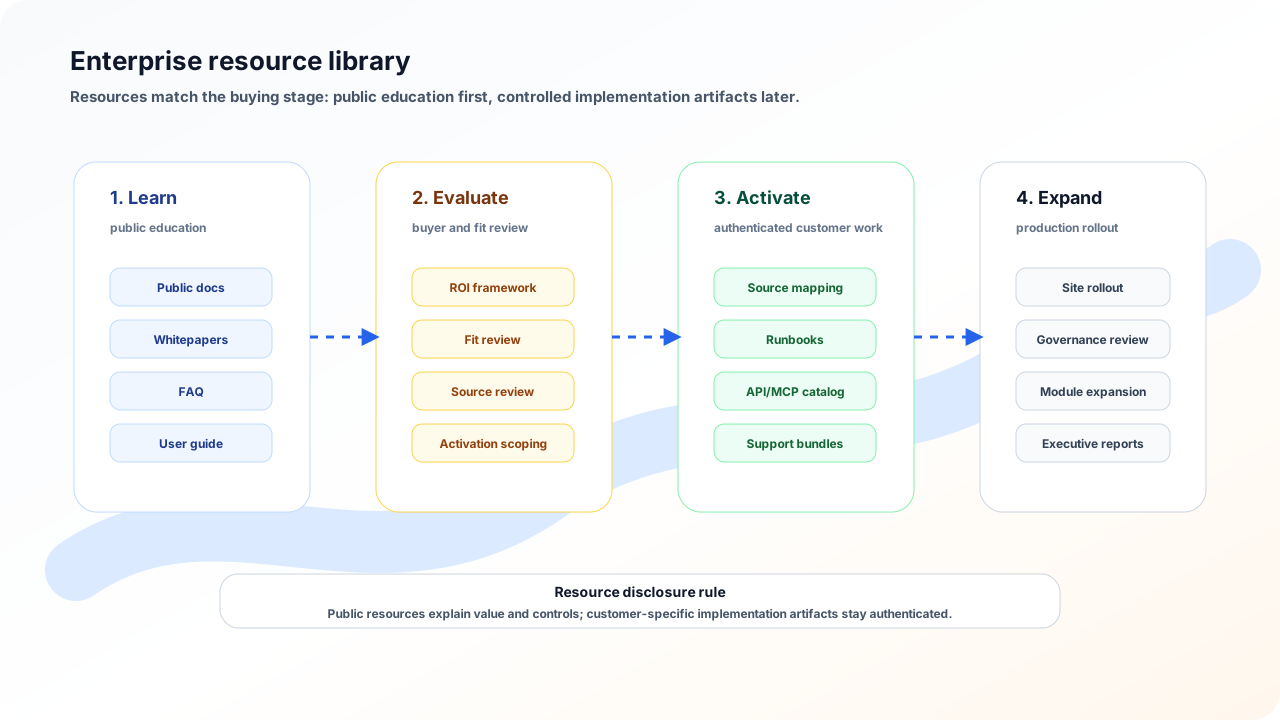
TwinEdge explains product value, user guidance, and adoption paths publicly while keeping tenant catalogs, credentials, support bundles, private service endpoints, and customer data behind authenticated access.
Authenticated API surfaces
Live API/MCP catalogs, test runs, external clients, audit feeds, and API keys require an authenticated customer or partner account.
Tenant-scoped data
Operational context, graph objects, telemetry, recommendations, and evidence are scoped by tenant, role, permission, and deployment boundary.
No public secrets
Credentials, source connection details, customer runbooks, and support artifacts are not published on public resource pages.
Governed action
Recommendations remain read-only first and move through validation, approval, audit, and replay before operational execution.
Outcomes
ROI users
Teams get the context, controls, and execution path needed to move from noisy industrial data to approved operational action.
Financial sponsors
Understand how operational value drivers map to activation scope, rollout cost, and expected payback.
Operations leaders
Connect savings and risk reduction to the workflows teams actually run every day.
Implementation teams
Use ROI assumptions to prioritize sources, asset classes, workflows, and evidence needed for the first activation.
Connected platform
ROI data boundaries
Public ROI pages explain the model. Customer-sensitive assumptions and operational data are handled through controlled engagement.
Public pages explain product scope, operating options, governance concepts, resource paths, and customer value without exposing tenant implementation details.
Authenticated customer access is used for tenant-specific API catalogs, MCP tools, API keys, implementation runbooks, support bundles, and evidence packages.
DataOps source mappings, graph context, validation results, and operational evidence stay scoped to the customer tenant and authorized roles.
API and MCP access is not an open public console; live calls require authentication, tenant scope, permissions, rate limits, and audit trails.
Implementation planning and customer-specific review can be handled through controlled disclosure and commercial engagement.
Free developer tools can be public utilities, but production connectors, enterprise integration paths, and customer data access remain governed.
Related for search and evaluation
Primary product for asset management and maintenance work.
Condition, physics, and remaining-life workflows.
Governed recommendations with approval and replay.
Maximo, HighByte, MaintainX, Fiix, and field alternatives.
Definitions for CMMS, DataOps, UNS, twins, and agents.
Labeled benchmarks and pilot methods.
Evaluate TwinEdge
Estimate operational value without exposing sensitive assumptions.
Use public value drivers for orientation, then build the detailed model through a private activation or ROI workshop.