Resources / Services
Activation services that move from fit review to implementation planning.
TwinEdge services help customers assess data readiness, connect a first source, activate an asset class or workflow, deploy TwinEdge OS where needed, and transfer the operating loop to customer teams through governed implementation material.
Discovery
Readiness
Source access
Pilot workflow
Implementation review
Handoff
Services are scoped around operational activation and controlled customer handoff.
Platform in action
Activation resources by stage
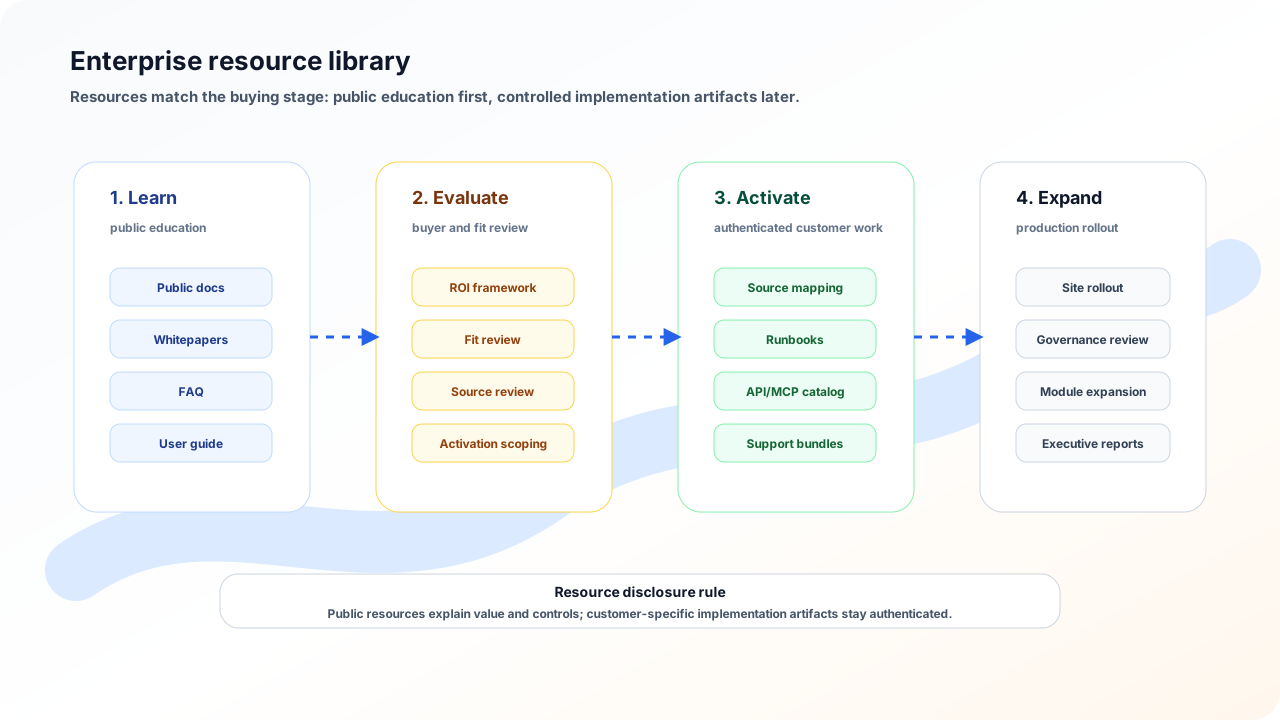
Public service descriptions explain the engagement model. Customer-specific source maps, runbooks, support bundles, and handoff evidence stay protected.
Workflow
Activation flow
Connect industrial sources, build trusted context, govern recommendations, and turn approved decisions into operational work.
Assess fit and readiness
Identify source systems, data availability, operational pain, security constraints, deployment pattern, and the first workflow worth proving.
Activate a focused workflow
Connect a source, map context, validate readiness, configure governed recommendations, and route approved action into work, field, reports, APIs, or MCP.
Transfer and expand
Deliver customer runbooks, support bundles, evidence, training, and rollout planning through authenticated access, then expand across sites and modules.
Capabilities
Service packages
Implementation review
Review operating boundaries, customer-controlled access, source connection options, identity, credential handling, approval paths, and audit expectations.
DataOps readiness
Assess source quality, tag coverage, schema readiness, model mapping, graph context, and validation gaps for the first operational workflow.
TwinEdge OS deployment
Support edge, no-cloud, hybrid, local dashboards, collector, OT Bridge, and site support-bundle patterns when plant connectivity requires it.
Workflow activation
Configure a focused use case such as maintenance, water operations, manufacturing OEE, quality, energy, lab, compliance, or field execution.
API/MCP enablement
Prepare authenticated API/MCP product catalogs, governance, rate limits, audit surfaces, and external client access for approved customer teams.
Handoff and rollout
Transfer runbooks, support bundles, evidence packs, training, success measures, and expansion planning to customer teams.
Customer-only handoff
Implementation artifacts stay behind authenticated access
Services can be described publicly, but the artifacts produced by services often contain customer-specific source maps, architecture details, and evidence.
Public
Service stages, engagement outcomes, activation examples, review paths, and expected enterprise handoff model.
Customer-only
Runbooks, deployment notes, tenant catalogs, source mappings, support bundles, evidence packs, and API access details.
Governed handoff
Artifacts are handed off through authenticated access, authorized roles, approval records, and customer-controlled storage patterns.
Engineering controls
Public resources without public tenant access.
TwinEdge explains product value, user guidance, and adoption paths publicly while keeping tenant catalogs, credentials, support bundles, private service endpoints, and customer data behind authenticated access.
Authenticated API surfaces
Live API/MCP catalogs, test runs, external clients, audit feeds, and API keys require an authenticated customer or partner account.
Tenant-scoped data
Operational context, graph objects, telemetry, recommendations, and evidence are scoped by tenant, role, permission, and deployment boundary.
No public secrets
Credentials, source connection details, customer runbooks, and support artifacts are not published on public resource pages.
Governed action
Recommendations remain read-only first and move through validation, approval, audit, and replay before operational execution.
Outcomes
Services outcomes
Teams get the context, controls, and execution path needed to move from noisy industrial data to approved operational action.
Operations sponsors
Prove one workflow with real source context and measurable operational value before expanding scope.
IT and OT teams
Resolve source access, deployment, security, identity, and support expectations before production rollout.
Implementation teams
Receive the runbooks, evidence, training, and support bundles needed to operate the platform after activation.
Connected platform
Service resource boundaries
Services engagements define scope, deliverables, access paths, and support expectations before implementation begins.
Public pages explain product scope, operating options, governance concepts, resource paths, and customer value without exposing tenant implementation details.
Authenticated customer access is used for tenant-specific API catalogs, MCP tools, API keys, implementation runbooks, support bundles, and evidence packages.
DataOps source mappings, graph context, validation results, and operational evidence stay scoped to the customer tenant and authorized roles.
API and MCP access is not an open public console; live calls require authentication, tenant scope, permissions, rate limits, and audit trails.
Implementation planning and customer-specific review can be handled through controlled disclosure and commercial engagement.
Free developer tools can be public utilities, but production connectors, enterprise integration paths, and customer data access remain governed.
Related for search and evaluation
Primary product for asset management and maintenance work.
Condition, physics, and remaining-life workflows.
Governed recommendations with approval and replay.
Maximo, HighByte, MaintainX, Fiix, and field alternatives.
Definitions for CMMS, DataOps, UNS, twins, and agents.
Labeled benchmarks and pilot methods.
Evaluate TwinEdge
Move from product fit to implementation planning.
Start with an activation discussion, then deliver tenant-specific artifacts, API access, and runbooks through authenticated customer channels.